
Testing the components of your IT environment is an ongoing challenge. Staying ahead requires understanding the latest attack techniques and evaluating your defences against evolving threats. This proactive approach is crucial for enhancing your cybersecurity posture.
What penetration testing actually involves
Explore NSP’s Penetration Testing to simulate real cyberattacks and identify vulnerabilities in your people, processes, and technology.
Find what's actually exploitable
Not just a scan of known vulnerabilities – a real attempt to get in, move through your environment, and reach your most sensitive systems. The way an attacker would.
Test every layer - network, apps, people
External network, internal network, web applications, cloud configuration, email security, and social engineering. We test the things attackers actually target, not just the things that are easy to check.
A report you can act on
Every finding explained in business terms. What was found, what an attacker could do with it, how likely exploitation is, and what to fix first. Written for the person running the business as well as the IT team.
The benefits of Penetration Testing
Know exactly where you're exposed
Internal teams often miss vulnerabilities because they’re too close to the environment. An independent pen test gives you an objective view of what’s actually exploitable – not just what looks secure from the inside.
Satisfy compliance requirements
ISO 27001, PCI DSS, and NZISM all reference regular penetration testing as a control requirement. NSP’s pen test produces a report formatted to support your compliance programme and your cyber insurance application.
Prioritise your security spend
Not every vulnerability is equal. Our report tells you which findings are critical, which are medium risk, and which can wait – so you’re fixing the right things first, not just the most visible ones.
Test your security tools, not just your systems
A pen test tells you whether the security tools you’ve invested in are actually working – whether your EDR would catch a real attack, whether your monitoring would detect lateral movement, and whether your incident response would kick in fast enough.
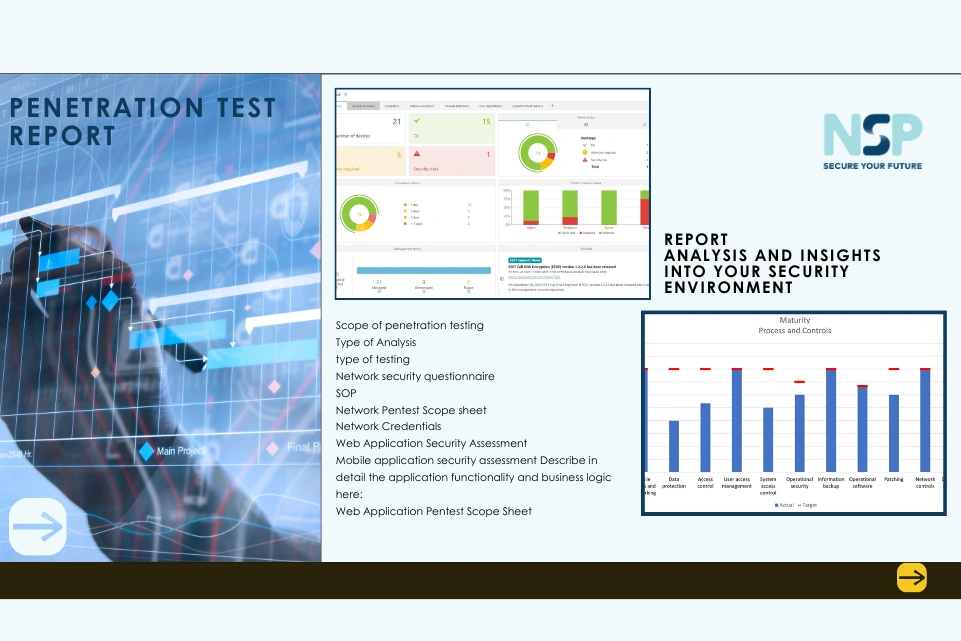
Every NSP pen test delivers a full written report covering every vulnerability found, how it was identified, what an attacker could realistically do with it, and the evidence from our testing. Findings are rated by severity – critical, high, medium, low – so you know immediately where to focus.
The report has two sections: an executive summary written for leadership and boards, and a technical detail section written for your IT team. Both sections include specific remediation guidance, not just a list of problems.
Most importantly – it’s written in plain English. If you need to present findings to a board, a client, or a cyber insurance underwriter, this report is designed to be shown.
What NSP delivers
-
What you get: a report that actually means something
-
What to do next - in the right order
How an NSP Pen Test Works
Step 1: Scoping
Before anything starts, we agree exactly what is in scope. Which systems, which environments, which attack scenarios. You decide what we test. We tell you what to expect, what access we need, and how we will work around your operational requirements. Nothing happens until scope is agreed and signed off.
Step 2: Testing
Our testers use the same tools and techniques that real attackers use – manual exploitation, not just automated scans. We attempt to get in, move through your environment, escalate privileges, and reach your most sensitive systems. Everything we do is documented so you know exactly what was tested, what was found, and how.
Step 3: Reporting
Every finding is documented with evidence, rated by severity – Critical, High, Medium, Low – and explained in plain English. What was found, how it was exploited, what an attacker could realistically do with it, and what to fix first. The report has an executive summary for leadership and a technical section for your IT team.
Step 4: Debrief & Remediation
We walk you through every finding. What it means for your business, how likely exploitation is, and what to prioritise. You leave with a sequenced remediation roadmap – what to fix this week, what to schedule, what to monitor. If you need help fixing what we found, NSP’s team can support that too. For compliance purposes, we can arrange a retest once remediation is complete.
What Type of Pen Test Do You Need?
External Network Penetration Testing
Testing your internet-facing perimeter – firewalls, VPNs, remote access tools, public-facing servers, and any system exposed to the internet. This is the view an attacker has before they get inside your network. Most NZ businesses start here.
Internal Network Penetration Testing
Testing what an attacker can do once they are already inside your network – whether from a compromised device, a phishing attack, or a malicious insider. We simulate lateral movement, privilege escalation, and access to your most sensitive systems and data.
Web Application Penetration Testing
Testing the security of your web applications, customer portals, APIs, and online services. We check for OWASP Top 10 vulnerabilities including injection flaws, broken authentication, and data exposure – the most commonly exploited weaknesses in business web applications.
Cloud Security Testing
Testing your cloud environments – Microsoft Azure, Microsoft 365, and cloud-hosted services – for misconfigurations, excessive permissions, insecure storage, and identity control weaknesses. Cloud misconfiguration is one of the leading causes of data breaches in NZ.
Social Engineering Assessment
Testing your people, not just your systems. We conduct simulated phishing campaigns and, where agreed, physical security tests to find out how your staff respond to real-world manipulation attempts. Your people are your biggest attack surface and the hardest one to patch.
Red Team Exercise
A full-scope, adversarial simulation that combines external, internal, social engineering, and physical security testing into one coordinated attack scenario. Red team exercises are designed for businesses that want to test their detection and response capability – not just their preventive controls.
What Every NSP Pen Test Delivers
Executive Summary
A plain-English summary of what we found, what the realistic risk is to your business, and what to do first. Written to be shown to your board, your leadership team, or your cyber insurer – not just your IT team.
Full Technical Report
Every finding documented with the evidence from our testing, the method used to exploit it, and the severity rating – Critical, High, Medium, Low. Your IT team gets a precise, actionable record of what we found and how we found it.
Prioritised Remediation Roadmap
A sequenced fix list ordered by severity and practical impact. What to address this week, what to schedule over the coming months, and what to monitor ongoing. Not just a list of problems – a plan for fixing the right ones first.
Debrief Session
We walk you through every finding in a live debrief. What it means, how exploitable it is, and what a real attacker could do with it. Questions answered, context provided. If you are presenting findings to a board or an insurer, we can help you frame that conversation too.
When Do You Need a Pen Test?
Some businesses need a pen test because they are required to have one. Others need one because something happened or because they want to know what would happen if it did.
Compliance requirements. ISO 27001, PCI DSS, and NZISM all reference regular penetration testing as a control requirement. If you are pursuing certification or maintaining compliance, a documented annual pen test from a professional provider is typically mandatory.
Cyber insurance. NZ insurers are increasingly asking for evidence of recent security testing at application and renewal. A pen test report from NSP is formatted to support your insurance application directly.
Significant environment changes. A new application, a cloud migration, a major infrastructure change, or a new integration with a third party. Each of these introduces new attack surface. A pen test after a significant change confirms your new environment is as secure as the old one.
After a security incident. Something happened – a breach, a phishing attack, suspicious activity. A pen test after an incident confirms what was actually compromised, identifies what else is exposed, and gives you confidence that the gaps have been closed.
Proactive risk management. You want to know what an attacker would find before they do. An annual pen test is the most direct way to answer that question.

Pen Test vs Vulnerability Scan - What Is the Difference?
A vulnerability scan is an automated tool that checks your environment against a database of known weaknesses. It is fast, repeatable, and useful but it tells you what might be exploitable, not what actually is.
A penetration test goes further. A skilled tester actively attempts to exploit the weaknesses a scan identifies and others that automated tools miss entirely. They simulate what a real attacker would do: chain vulnerabilities together, escalate privileges, move laterally through your environment, and reach your most sensitive systems.
The difference in output is significant. A vulnerability scan gives you a list. A pen test tells you what is actually dangerous, what an attacker could realistically do with it, and what to fix first.
Most compliance frameworks – ISO 27001, PCI DSS, NZISM – specifically require a penetration test, not just a vulnerability scan. Most cyber insurers do too.
NSP offers both. If you are not sure which is right for your situation, our team will help you scope the most effective engagement for your environment and objectives.

How We Test - Methodology
NSP pen tests are conducted using established, recognised methodologies – not proprietary checklists.
Frameworks we test against and reference:
– OWASP Testing Guide – the standard for web application security testing, covering the OWASP Top 10 and beyond
– NIST SP 800-115 – the technical guide to information security testing and assessment
– PTES (Penetration Testing Execution Standard) – a comprehensive framework for the full pen test lifecycle
– MITRE ATT&CK – the adversarial tactics and techniques matrix used to map findings to real-world attack patterns
Who does the work:
NSP pen tests are led by senior security practitioners with hands-on experience across a range of NZ and international environments. Our team is led by Geordie Stewart – CISO, MSc, CISSP – with more than 20 years of cybersecurity experience. You are not getting a junior analyst working through a checklist. You are getting someone who understands how real attacks unfold and knows where to look.
For businesses with specific compliance requirements, we can tailor our methodology and report format to match what your auditor or insurer needs.

What Our Clients Say
Neil
Global IT Manager
F&B Distributor
We were pleased that NSP could conduct an independent review, assess our environment, understand security trends and weaknesses, and provide a comprehensive cybersecurity roadmap.
Pam
Chief Executive
Charity Organisation
NSP played a crucial role in resolving significant technological challenges linked to our legacy system. As a charitable organization, operational efficiency with limited resources is critical. A resilient infrastructure and a reliable technology partner are essential for our success, and NSP proved to be the perfect match for our needs.
Josh
IT Manager
Commercial Leasing Company
NSP delivered and continues to deliver inspired solutions for our customers tailored to their needs.
Paul
CFO
Government Housing
NSP vCISO understood our requirements and his practical approach helped us build a strong security system.
Ready to find out what an attacker would find?
Frequently Asked Questions
1. WHAT IS PENETRATION TESTING?
Penetration testing – also called a pen test or ethical hacking – is an authorised simulated attack on your systems, carried out by security professionals to find vulnerabilities before real attackers do. NSP’s pen testers use the same techniques and tools that attackers use, but under a controlled scope agreed with you before testing starts. The goal is to find what’s actually exploitable – not just what shows up on an automated scan.
2. WHAT DOES AN NSP PENETRATION TEST INCLUDE?
NSP offers penetration testing across external networks, internal networks, web applications, cloud environments, and social engineering. Every engagement includes a scoping phase to agree what’s being tested, active testing using manual and automated techniques, and a full written report with severity-rated findings and a prioritised remediation roadmap. We also provide a debrief walkthrough of the findings for your team.
3. WHAT IS THE DIFFERENCE BETWEEN A PENETRATION TEST AND A VULNERABILITY SCAN?
A vulnerability scan is an automated check for known weaknesses – it tells you what might be exploitable. A penetration test goes further: a skilled tester actively attempts to exploit those weaknesses and others, simulating what a real attacker would do. A scan gives you a list. A pen test tells you what’s actually dangerous. Most compliance frameworks and cyber insurers require a pen test, not just a scan.
4. HOW OFTEN SHOULD YOU DO A PENETRATION TEST?
At minimum, annually and whenever there’s a significant change to your environment such as a new application, cloud migration, or major infrastructure update. ISO 27001, PCI DSS, and NZISM all reference regular penetration testing as a requirement. If you’re applying for or renewing cyber insurance, your insurer may ask for evidence of recent testing. NSP can help you build a testing programme that fits your risk profile and compliance obligations.
5. DO I NEED A PENETRATION TEST FOR CYBER INSURANCE?
Increasingly, yes. NZ cyber insurers are asking for evidence of regular security testing before underwriting or renewing policies. A documented pen test from a professional provider is one of the strongest signals you can provide. If you also need a broader cyber insurance readiness assessment, NSP’s cyber insurance assessment service covers the full picture.
6. HOW LONG DOES A PENETRATION TEST TAKE?
It depends on scope. A focused external network test or web application test typically takes 3–5 days of active testing. Larger environments or more complex engagements – internal network, cloud, social engineering combined – can take 1–2 weeks. We agree the scope and timeline with you before anything starts, and we work around your operational requirements.
7. HOW MUCH DOES PENETRATION TESTING COST IN NZ?
Cost depends on scope, environment complexity, and the type of testing required. As a general guide, focused engagements for SMEs typically start from a few thousand dollars, while more comprehensive tests covering multiple environments are priced accordingly. NSP provides a clear, fixed-price quote based on the agreed scope before testing starts – no surprises. Get in touch for a scoping conversation.
8. WHAT TYPES OF PENETRATION TESTING DOES NSP OFFER?
NSP offers external network penetration testing, internal network penetration testing, web application penetration testing, cloud security testing, and social engineering assessments. If you’re not sure which type is right for your business, our team will help you scope the most effective engagement for your environment and objectives.
9. WHAT IS THE DIFFERENCE BETWEEN BLACK BOX, WHITE BOX, AND GREY BOX PENETRATION TESTING?
These terms describe how much information the tester is given before testing starts. Black box testing means the tester starts with no prior knowledge of your environment – simulating an external attacker with no inside information. White box testing means the tester is given full access to documentation, source code, and network diagrams – useful for deep technical reviews of specific systems. Grey box is the most common approach: the tester is given some context (for example, valid credentials or network diagrams) to focus testing on the areas that matter most. NSP will recommend the most appropriate approach for your objectives during scoping.
10. WHAT IS THE DIFFERENCE BETWEEN A PENETRATION TEST AND A RED TEAM EXERCISE?
A penetration test has a defined scope, a known timeframe, and is focused on finding as many vulnerabilities as possible within that scope. A red team exercise is broader and more adversarial – the red team is given an objective (for example, “access the finance system”) and uses any means necessary to achieve it, including social engineering, physical access, and extended dwell time. Red team exercises test your detection and response capability, not just your preventive controls. Most businesses start with a pen test. Red team exercises are suited to organisations that already have a mature security programme and want to test it under realistic conditions.
11. CAN A PENETRATION TEST CAUSE DOWNTIME OR AFFECT MY SYSTEMS?
This is one of the most common concerns and it is a legitimate one. NSP takes precautions to avoid causing disruption during testing. Before testing starts, we agree on what is in scope, what is out of scope, and what to do if something unexpected happens. We avoid destructive tests unless specifically agreed, and we work around your operational hours where required. In rare cases, vulnerability exploitation can cause unexpected behaviour in legacy systems – this is discussed during scoping so you can make an informed decision about what to test and when. The short answer: disruption during a well-scoped, professionally conducted pen test is uncommon and manageable.
12. SHOULD I FIX KNOWN VULNERABILITIES BEFORE A PENETRATION TEST?
It depends on your goal. If you want to know your actual current security posture – what an attacker could exploit right now – do not patch first. The test results are more useful when they reflect your real environment. If you have already fixed known critical vulnerabilities and want to confirm the fixes are effective, tell us during scoping and we will focus accordingly. For compliance-driven tests, your auditor or insurer typically wants the test to reflect your live environment at the time of testing.
13. WHAT SHOULD WE DO AFTER THE PENETRATION TEST?
Start with the Critical and High severity findings. These are the vulnerabilities that represent real, exploitable risk to your business right now. Your remediation roadmap from NSP sequences the fixes for you – you do not need to decide the order yourself. Once critical findings are addressed, work through the Medium and Low items on a schedule that fits your resources. For businesses with compliance obligations, NSP can conduct a retest after remediation to confirm findings have been resolved and to produce updated documentation for your auditor or insurer. If your pen test reveals structural security gaps rather than just individual vulnerabilities, a vCISO engagement can help you address the underlying programme issues.
View more
Learn more about NSP's Cybersecurity solutions
Cyber Security Assessments
Your pen test supports your coverage
Not sure where to start? A security assessment gives you a broader view of your security posture before you scope a pen test - so you're testing the right things.
Cyber Insurance Assessments
Your pen test supports your coverage
Many NZ insurers ask for evidence of regular security testing. NSP's cyber insurance assessment helps you use your pen test results to support your application or renewal.
Vulnerability Management
Keep the gaps from coming back
A pen test is a point-in-time view. Vulnerability management keeps your environment continuously monitored so new risks are caught between tests.
vCISO Services
Turn findings into a strategy
If your pen test uncovers structural security gaps, a vCISO gives you the leadership to address them and builds the programme that prevents them recurring.
Managed Detection & Response
A pen test is a point-in-time view. NSP's MDR service watches your environment 24/7 - detecting threats between tests and responding before they become incidents.
Incident Response
If a pen test uncovers a live incident or if something goes wrong before you get to test - NSP's incident response team can mobilise immediately to contain and recover.
Discover NSP resources on Security
Stay up to date with our resources on Modern Workplace, AI, Cloud, Managed services and Cybersecurity.

Cybersecurity
Basic Cyber Hygiene Works. Why Are NZ Businesses Still Hit?
The NCSC Says Basic Cyber Hygiene Still Stops Most Attacks. So Why Are NZ Businesses Still Getting Hit? The NCSC's Cyber Threat Report 2026 contains a finding that should be reassuring and is, in practice, deeply frustrating.
October 18, 2026

Cybersecurity
Financially Motivated Cyber Attacks on NZ Businesses Up 18% | NSP
Financially Motivated Attacks on NZ Businesses Are Up 18%. Here's Where the Money Goes.
October 18, 2026

Cybersecurity
Identity Security Beyond MFA | NSP
MFA Protects Your Login. What Protects Everything Around It?
September 27, 2026

Cybersecurity
Christchurch Construction Cyber Security: The Monitoring Gap | NSP
Christchurch Construction and Engineering Firms: The Cyber Threat You're Probably Not Monitoring For When the ZenTech ransomware attack was confirmed in Dunedin on 10 September 2026, most of the coverage focused on the clinical trial data that was taken. What received less attention was the operational profile of the victim: a project-based, specialist organisation working with sensitive commercial data across a complex network of clients, contractors, and research partners.
September 23, 2026

Cybersecurity
Why NZ Healthcare Needs 24/7 Security Monitoring in 2026 | NSP
NZ Healthcare Had Five Cyber Breaches in Nine Months. Monitoring Is No Longer Optional. In the nine months between December 2025 and September 2026, five separate organisations with New Zealand healthcare connections confirmed significant cyber incidents.
September 23, 2026

All you need to know about Pen testing
This eBook provides business leaders with a practical, concise, and informative guide to taking the most important step towards your digital security. The goal is to gain a good understanding of all you need to know about Pentesting to evaluate your network infrastructure and identify cybersecurity vulnerabilities.